| Home The Word | ||||||||||
| Michael the Archangel | ||||||||||
|
Scripture tells of an archangel.. This archangel is named Michael. He is found in the Old and New Testament.
|
||||||||||
|
But who is this Archangel?
The word archangel comes from the Greek words archo and aggelos. The definition of Archo is "to be first, to reign (rule) over" (Strong 757). Aggelos in English means "angel" (Strong 32). Archangel is "the one who is first, who rules over the angels." An "angel," translated from the Hebrew word malak (Strong 4397), is a
"messenger."
An
angel can be reference to a messenger that comes from the heavens
or one that dwells on earth.
It is usually written in Scripture
with the implication of one who is sent from
heaven by God to give a message to man.
Angels are commonly found in Scripture
in both the Old and New Testaments.
|
||||||||||
|
||||||||||
|
Scripture calls them ministering spirits designed to serve God.
(To "minister" from Greek diakonia: to serve) (Strong 1248).
In order to better understand Scripture through its study that relates to Michael, one should keep in mind that it is the messenger Jesus, begotten of the Father and Creator of all "that are in heaven, and that are in earth," who is the "first" (Col. 1:15-20) and lead "Servant" (Isa. 53:11, Mark 10:43-45). (Isa. 53:11, "servant" from Hebrew ebed: bondman, servant) (Strong 5650) (Mark 10:44, "servant" from Greek doulos: slave, bondman, servant) (Strong 1401)]. If an angel is God's ministering servant then an archangel is the first or head ruler of the ministering servants of God. The word "archangel" is used only in the New Testament and only in reference to Michael (Jude 1:9) and
Jesus (1 Thess. 4:16). However, the Old Testament refers to this same angel Michael in the book of Daniel where he is called a "great
prince." (Dan. 12:1).
In the KJV, Daniel calls him "one of the chief princes."
The word "one" is a translation from the Hebrew word"echad" and means "one," but it can also mean the
"first" of that which is one (Strong 259). When it is translated as "one" as in the KJV, the meaning implied would
be "one united or a part of more than one comprised as one." When the word is translated as "first," the meaning has a slight variation
because it implies the "one" is the "first" in a union that is united and one, the leader of more than one of something which is comprised
as one.
While KJV translates the word as "one," Young's Literal Translation uses the word "first."
This translation shows there is a hierarchy amongst angels.
Some are put in charge of others. Michael is called the leader of the chief or leading angels, which makes him the leader
of all the angels.
When the word "first" is used, Michael is given the same recognition as in the New Testament (Rev. 12:7) which
puts him first above all angels under the title "archangel."
An angel who visits Daniel tells him Michael is
not just a prince. He is Daniel's prince which makes him prince of Israel.
Recall in Daniel 12:1, Michael
is called "the great prince which standeth for the children of thy people." Because he represents the chosen angel of God's people,
he is prince of Israel.
Verse 21 reemphasizes Michael as Israel's prince.
That Michael is referred to as
a prince of Israel, shows He is leader of both the angels and the Jewish people which makes him the first of many, showing
Young's Literal translation of Daniel 10:13 to be accurate.
But Michael is not the only one who is given these titles. Interestingly,
Jesus is also Leader of the angels (Matt. 25:31) and Prince of Israel (Acts 5:31).
And in Colossians 1:15-20 Paul
calls Jesus the "first" above all created, coinciding with Young's version of Michael being the "first" (Daniel 10:13).
Both
Jesus and Michael share the titles "first," the"leader of the angels," and "Prince of Israel."
Daniel is not the only
one in the Old Testament who had an encounter with this leading angel.
Moses speaks of a godly angel who appears to him
from a burning bush.
The One who appeared to Moses
is called an "angel" (Strong 4397). In verse 2, He is called an "angel of the Lord," whereas, in verse 4, He is simply referred
to as the LORD. It is the LORD God who appeared to Moses as an Angel which is why the ground was holy: "the place whereon thou
standest is holy ground"(v. 5).
Moses is given God's name "I Am that I Am." The Angel speaking to Moses is "I
Am."
Moses later says the LORD led the Israelites "by day in a pillar of cloud... and by night in a pillar of fire..."
...and then says it was "the angel of God" who led the Israelites as a pillar.
Again Moses is showing
this angel (Strong 4397) of God to be God.
Moses says this "Angel" is a leader of Israel.
The Angel (Strong 4397) leads the people.
Notice God warns
the people to obey this Angel ("obey his voice") if they want a "pardon" from their "transgressions." That's profound. This
angel was to be obeyed and he could forgive sins ("transgressions"). It also says God's name was "in him" (v. 21).
God's
name in Him means He is the "I am" Angel who visited Moses at the burning bush.
What "Angel" would have the "I am" voice
and power of God and with it the power to forgive sin? Only God can do that. This "Angel" could only be a God.
This
Scripture also tells us there is a leader God of Gods talking about a Leader God of humanity.
It amazingly
runs parallel to New Testament theology that teaches God the Father works through God the Son Jesus (John 14:6-11) who is given
authority to forgive sin (Matt. 9:1-7, Rom. 3:21-26).
God the Father is talking about God the Son. God the Son is the Angel.
[King
James Version actually capitalizes the word "Angel" so it was understood by the translators of the text that this verse was talking
about the Lord Jesus.]
Later, Moses says it is this Angel (Strong 4397) who leads Israel.
Joshua,
who led the children of Israel after Moses, was visited by the same Angel. When the angel visits Joshua, he is called a
man.
This man is "captain of the Lord's host." He tells Joshua
that "the place whereon thou standest is holy," the same thing God told Moses at the burning bush (Ex. 3:5). Because the ground
was called holy, Joshua was in God's presence. Obviously, the "man" who visited Joshua was no ordinary man but God, the same God who
was the Angel who visited Moses as it was similar to the Moses incident.
Since this "man" is the Angel who visited
Moses at the burning bush, then he is also the same "angel" who lead the Israelites as a "pillar of cloud" by day and "pillar
of fire" by night.
Joshua worships this man (v. 14) which proves he is none other than God because only God is
allowed to be worshipped (Rev. 19:10).
[Note here that while God is not "man," a created being weak in the flesh
(Num. 23:19), He has become "man" in the form of Jesus in the New Testament and has appeared at times as a "man" to Old Testament
worshippers. The story of how Jacob in the Book of Genesis is renamed by God is also another example of Jesus as a "Man," yet God,
in the Old Testament. The Scripture refers to a "man" who wrestled with Jacob. Later, Jacob said that he had "seen God face to face."Gen. 32:24-30.]
Because this "man" who appeared to Joshua was "captain of the Lord's host," this makes him the
leader of the host. Since the "Lord's host" is the angels of God and this man was their leader then he was
the leader of the angels, the same title given to Michael and to Jesus.
By referencing Old Covenant with New Covenant
Scripture, one can conclude that this "Angel" is the Lord Jesus.
In the Book of Acts, Jesus' follower Stephen
spoke of the "angel" (Strong 32) who appeared to Moses when he was martyred for Christ.
Notice he mentioned a "prophet...shall
ye hear" and an "angel," both alluding to Christ.
He said this angel (Strong 32) is the Angel (Strong 4397) that spoke to Moses at
Sinai ("the angel which spake
to him in the mount Sina").
The pillar who led the Israelites was called the "Rock" (Strong 4037) "...and that
Rock was Christ."
Conclusion:
Stephen mentioned the "angel" who appeared to Moses at the burning bush, alluding that
he was the "prophet" and therefore Christ.
Paul admitted that the "Rock" that was the pillar that lead the Israelites ("that
followed them") was indeed Christ.
Moses said this "Rock" who lead the Israelites was the same Angel who met him at Sinai.
Since Paul said this "Rock"is Christ, then the Angel who met Moses at Sinai is also Christ.
This means Jesus is the
God Angel "I Am" who visited Moses.
And that's exactly who Jesus said He is...
Scripture verifies there is an angel who is called a God as God's Son. Yet
Hebrews says no angel was ever called the Son of God. That title was reserved for the "firstbegotten"...
...who is the
"firstborn of every creature."
Since no angel is a God as God's Son, then how can the "angel" of which Moses spoke be a God?
Hebrews' "angels"
was referring to those in heaven created by God. It was not referring to their Leader. The difference is that they were created and
not begotten like the Son.
Note Hebrews does say Jesus is the "firstbegotten" which is another title for Leader of those He created,
and Colossians calls Him "firstborn of every creature," which would include the angels, so this makes Him the "first" of the
angels as He is called in Dan. 10:13.
The only begotten Son is only begotten because only He, with the Father
and Spirit, is part of the Godhead (Col. 2:9). He is "firstbegotten" because He is the first to be resurrected
from death (1 Cor. 15:22-24), making Him the "firstborn of every creature," which will allow others to be resurrected
later. Hebrews points out the Son's first begotten identity.
God's Son is an Angel because He is a Messenger for God
the Father (the meaning of the name "angel" being "messenger").
Malachi calls Jesus a messenger when he prophesies
Jesus' ministry.
The first messenger ("malak": angel) (Strong 4397) is John the Baptist who would prepare the way for Jesus.
The second
messenger ("malak": angel) is Jesus, the "messenger of the Covenant" who would deliver the teachings we read about in the New
Testament.
So, as a messenger, Jesus is an Angel since the word "angel" means "messenger."
As an angel, He is the
Leader of all those angel messengers He created which means Moses' Angel was the leader of these created beings. Both are
angels because both are messengers who serve God.
Now that we have established Jesus as the "angel" prophesied by
Moses and others in Old Covenant, how can we relate this "angel" to the name Michael as found in "Michael the Archangel?"
Like
the word "angel" (messenger), we need an understanding of the name translated to English.
In Hebrew, the name Michael (Miykael)
means "who is like God" (Strong 4317). Here, we see the likeness of God, for no other "angel" is given a name with a meaning
that is compared to God.
The name "Michael the Archangel" means "who is like God (Michael) who is first and leader
of messengers (archangel)." Notice how this describes Jesus.
[Reference back to Exodus 23:21 where Moses speaks of the
Father as saying about the "Angel" of God: "for my name is in him." It is the name Michael that has the "name" of God in him and therefore
it can be said of the "angel" Michael "my name is in him."]
Michael the Archangel's appearance was revealed to Daniel in
the form of a "man."
This is the description of the "man" in Daniel's vision:
Compare this to what the disciple John seen in a Revelation of
what Jesus looked like before He was born as a man on earth.
And the description of the "man" seen by John:
[The
"voice as the sound of many waters" is a depiction. The word "water" in the Book of Revelation was used to describe many people (Rev.
17:15). The meaning implied is that the voice sounded like a multitude of people.]
Now compare the visions of Daniel and John.
Notice the similarities
of the "man" seen in each of the visions, such as: face as lightening where head is white, similar garment, eyes as a flame or
fire, feet like brass, and voice as "many waters" which describes a "multitude" of people.
The "man" seen by Daniel was the same
"Son of man" as seen by John.
According to the apostle John, this man is Jesus. And that make Jesus Michael.
The Book of
Daniel was written over 2500 years ago and more than 500 years before the time of Christ. But God's prophet Daniel was given a vision
of Michael the Archangel which was a vision of Jesus before He was born on this earth.
Daniel's Chapter 10 reviewed
in entirety reveals a deeper understanding of the prince Michael.
Verses 5-9: Daniel sees a "man" he describes.
Verses
10-15: Daniel is visited by an angel, messenger, who tells him that God heard his prayer ("from the first day that thou didst
set thine heart to understand") (v. 12), and that he (the angel) "am come for thy words," meaning he was sent to speak to Daniel and
to give him an answer about his prayer. The angel goes on to tell Daniel that he was "withstood" from coming to Daniel by
"the prince of the kingdom of Persia," but Michael " one of the chief princes" came to help him and he remained there with the king
of Persia (v. 13). [Remember this "one of the chief princes" is translated by Young's as "first of the chief heads."]
Verse 14: The
angel tells Daniel that he is now "come to make" Daniel "understand what shall befall" his "people in the latter days."
Verses 16-17:
"One" in the likeness of the "sons of men" appears to Daniel. Daniel speaks to him and calls him "lord."
Verses 18-20: The same "one"
who appeared to Daniel in v. 16-17 "again" appears to Daniel. Daniel this time refers to him as "the appearance of a man." This man
strengthens Daniel, then speaks to him and tells him that he is greatly beloved of God and to be strong. He then tells Daniel that
he will return to fight with the prince of Persia and when he has gone, the prince of Grecia shall come.
In the final verse, he tells
Daniel that there is none that "holdeth" with him in these things, or matters, but "Michael your prince."
[Young's Literal Translation
also translates this word "prince" as "head.]
The vision:
Daniel sees a description of a "man." He is visited by
an angel who gives him a message from the Lord. This messenger sent from God visits Daniel three times, encourages him, and gives
him strength.
He tells Daniel that he was "withstood" by the prince of the kingdom of Persia and needed help from the "first
of the chief heads," Michael.
He later makes another reference to Michael, telling Daniel that Michael is Daniel's "head."
The "man"
seen by Daniel is important for the rest of the vision. When Daniel is told by an angel that Michael's assistance was needed,
the "man" was shown to Daniel so that Daniel would know to whom the angel was making reference. This "man" was Michael.
The
conclusion according to this vision given to Daniel, based on the description of Michael: Michael is Jesus.
We learned from
previous Scripture that Jesus in prophecy is referred to as an "angel" or messenger. In Daniel's vision, Michael is called the
head and the leader of the leading angels.
Something to consider:
If Michael is the primary leader of the messengers of
God and Jesus is also called a messenger and leader of angels, then would it not also seem likely that Michael is Jesus?
And if
Michael were not Jesus and Michael is not only leader of the angels but leader of the leading angels, since Jesus
is also an Angel (Messenger), then He would be leader of Jesus. Of course this could not be accurate since Jesus as God is leader
of all creation including the angels.
It makes since that Jesus is Michael.
Another point is that there are similarities
between Michael and Jesus in that the "head" Michael of the Old Covenant is relative to God's Jewish people as the "Head"
Jesus of the New covenant is relative to the church.
We know according to New Covenant Scripture that there is only One Who is
"head" of man (1 Cor. 11:3).
This is Jesus, the "chief cornerstone" (Luke 20:17), the Head of the church (Col. 1:18).
Remember
earlier it was shown that both Michael and Jesus share the title of "leader of the angels."
New Covenant Scripture where Jesus
is Leader of the angels:
Compare with Matthew 26:53 where Jesus says the angels who follow Him obey Him.
Jesus
has more than one army in heaven.
These armies are "clothed in fine linen, white and clean."
They are the bride of the Lamb, the church (Eph.
5:25). The bride is the saints of God.
Compare to Joshua's encounter with the Lord.
A man visits Joshua and tells him that he is "captain
of the host of the LORD." The captain leads his army. This is Jesus.
Jesus is "captain of the host of the LORD" (Josh. 5:14) and
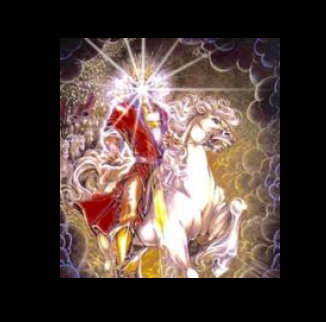
Leader of "the armies which were in heaven" (Rev. 19:14).
And as captain of His army, it is Jesus who will bring those who
have fallen asleep back to life.
The voice of the Lord will bring to life those who hear His voice.
The Lord will shout "with the voice of an archangel (chief messenger)." The archangel is Jesus.
As chief-messenger,
Jesus is the First (Leader) of the chief princes (leading angels) of the messengers of God (angels).
Jude also calls
Michael an archangel.
Michael, "when contending" for the body of Moses,"
simply said "the Lord rebuke thee." Michael was clearly referring to someone else other than himself as Lord. So,
how can Michael be a Lord (the Lord Jesus) if He calls someone else this name?
Remember there are two who are called Lord:
Father and Son (Ps. 110:1, Matt. 22:41-45).
The prophet John told of how Michael would fight against the enemy of
God.
Michael won the battle and defeated the enemy.
John purposely wrote about prophecy
he knew was already fulfilled in Jesus. This was written so that the readers would have a better understanding of what happened, why,
and what would follow.
When Jesus "beheld" the enemy
fall, He prophesied His crucifixion and resurrection. He knew what was to take place and what He was to accomplish.
The battle
began in the garden and was finished at the Cross. The Archangel Jesus won...
...and salvation has been the prize for all
to be given the opportunity to claim. This our Savior did for us so that all may have a chance of obtaining eternal life
in the kingdom of God (Luke 9:27, John 3:16, 1 Tim. 2:3-5)
... which came with Jesus.
The Great Prince Jesus was born into this world as the Messenger who would "stand
up" for His people...
...and since then a "time of trouble" would
follow. (We see this in the persecution of Christians and the Jewish people.)
Jesus was and is the Chief Messenger for both
angel and man. To understand this is to understand why it was important for Him to deliver the "message" of the Gospel while
He walked among us. It would prepare the way for the kingdom.
You see, the Teacher is the Messenger.
-------------------------------------------------------------------------------------------------------------------------------------------------------------------------
Further
Scripture study:
Matthew 9
5 For whether is easier, to say, Thy sins be forgiven thee; or to say, Arise, and walk?
6 But that ye
may know that the Son of man hath power on earth to forgive sins, (then saith he to the sick of the palsy,) Arise, take up thy bed,
and go unto thine house.
7 And he arose, and departed to his house.
Isaiah 53
11He shall see of the travail of his soul, and shall
be satisfied: by his knowledge shall my righteous servant justify many; for he shall bear their iniquities.
Isaiah 9
6 For unto
us a child is born, unto us a son is given: and the government shall be upon his shoulder: and his name shall be called Wonderful,
Counsellor, The mighty God, The everlasting Father, The Prince of Peace.
1 Thessalonians 4
16 For the Lord himself shall descend
from heaven with a shout, with the voice of the archangel, and with the trump of God: and the dead in Christ shall rise first:
17 Then
we which are alive and remain shall be caught up together with them in the clouds, to meet the Lord in the air: and so shall we ever
be with the Lord.
18 Wherefore comfort one another with these words.
Matthew 25
31 When the Son of man shall come in his glory,
and all the holy angels with him, then shall he sit upon the throne of his glory.
Jude 1
14 And Enoch also, the seventh from Adam,
prophesied of these, saying, Behold, the Lord cometh with ten thousands of his saints,
Revelation 19
11 And I saw the heaven having
been opened, and lo, a white horse, and he who is sitting upon it is called Faithful and True, and in righteousness doth he judge
and war,
12 and his eyes [are] as a flame of fire, and upon his head [are] many diadems -- having a name written that no one hath known,
except himself,
13 and he is arrayed with a garment covered with blood, and his name is called, The Word of God.
______________________________________________________________
Works
Cited
Strong, James. Strong's Exhaustive Concordance of the Bible. Hendrickson Publishers, Incorporated, 2009.
|
||||||||||