| Home Extras | ||||||
|
Shroud of Turin
|
||||||
|
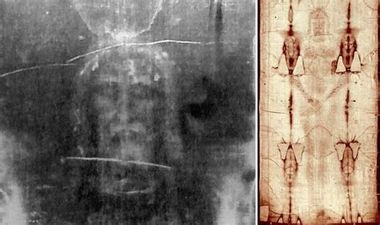
In the Cathedral of Saint John the Baptist in Turin, northern Italy
there is a burial cloth called the Shroud of Turin.
To some, this Shroud
is still a mystery. Many Catholic and other Christians believe it to be the
actual burial cloth of Jesus.
The
gospels tell us there was such a cloth (John 20:5-8). But is the Shroud
currently kept in the Cathedral of Saint John the
Baptist in Turin the actual
burial cloth of Christ as described by the Gospels? This is a question that has
been of much
debate for many years.
In 1390, Bishop Pierre d'Arcis wrote a memorandum to Pope Clement VII
declaring the Shroud a forgery
and a painting, and claiming that there
was a confession by the person who did the artwork. There is no name
given as to who this
supposed forger was. Claiming the Shroud a forgery
could have been the Bishop's attempt to reroute the masses going
to see the
Shroud. The bishop wanted to update the cathedral in Troyes(France), and needed
the income from the masses to
do so.
|
||||||
|
||||||
|
There are supported witnesses of the legitimacy of the burial cloth from earlier history. Gregory Referenda in A.D. 944
gave a sermon on the subject of the burial cloth. Another witness of the Shroud is the Codex Pray, an Illuminated
manuscript written in Budapest, Hungary between A.D. 1192 and 1195. The burial of Jesus with an image and cloth identical
to that on the Shroud is depicted within its five illustrations.
The earliest record of the Shroud besides the New
Testament Gospels is the Gospel of the Hebrews, the original letter to the Hebrew-speaking people written by Matthew. Later
translated to Greek as found in the first Book of the New Testament, some of its content was apparently left out during
translation according to those who cited from it such as St. Jerome of Alexander. The Gospel mentions the burial cloth of Jesus.
More recent scientific research has been conducted to examine
the Shroud. In 1978, a scientific analysis was made by STURP (Shroud of Turin Research Project). Specifically assigned for this
task was a group of American scientists. Their initial analysis proved that the image on the Shroud was not made by
paint or any other medium. After many hours of observation, the science experts concluded that they could not explain how the
image on the Shroud was made (Shwortz, "A Summary").
In 1988, samples from the Shroud cloth were given to three different
laboratories who used carbon dating on the cloth. They gave the Shroud a dating of A.D. 1260-1390 based on the carbon
samples ("Nature"). The piece cut from the Shroud for the test was taken from its corner.
Chemist Ray Rodgers, one of the
leading scientists of STURP, was later given information that the original carbon dating results could be inaccurate. It was
reported that the cloth piece taken from the corner of the Shroud for chemical analysis could have been a late
medieval patchwork and not part of the original Shroud. Based on this information, Rogers re-examined some of the material from
the Shroud which he was able to obtain in his possession. His investigation in the matter was to prove that the carbon dating was
accurate. To his surprise, the results he obtained from further analysis showed to be the opposite. His final report made
in 2004 of the analysis testify that both a vanillin test and current carbon dating prove the sample cloth taken from the
Shroud to be a medieval piece of material stitched in with the original Turin cloth. His work shows the Shroud
is actually much older than the original carbon dating test results. He concluded that the Shroud is very likely to be the original
burial cloth of Jesus.
Further carbon dating is needed if a more precise
dating is to be acquired.
It is difficult to achieve an accurate carbon dating of the Shroud because a chemical
treatment was more recently used in the box where the Shroud is kept to get rid of a bug infestation, a treatment known
to flaw proper carbon analysis. The Catholic Church currently holds the"charred" sample contents of the Shroud which could be used
to get more accurate results.
An interesting fact about the crucifixion of Christ is that medieval and more recent pictures
often depict the Lord as having been crucified through the palms of the hands. Archaeological finds show the victims of crucifixion
in early first century Rome were nailed through the wrists of the hands (Caramelli). The wrists were considered
part of the hands, i.e "in his hands the print of the nails" (John 20:25). In common with the archaeological finds, the man on
the Shroud received nails through the wrists. The feet of crucifixion victims received nails through the ankle ("New Evidence").
The
image on the Shroud also shows the man to have been viciously beaten before being crucified. Its detailed analysis coincides
with the four gospels although they underscore how much torture Christ suffered as evidenced on the Shroud. Like the man
of the gospels (John 19:1), the man on the Shroud received lashes on his back from a Roman flagrum.
Further evidence of the Shroud
as the actual burial cloth of Christ can be found from its cloth consistency and similarities with the face cloth of Christ,
and matching pollen grains and coins used (on his eyes) that date to the time of Christ (first century) and where He was crucified
(Jerusalem).
How did the image of the man appear on the Shroud? This is a question that many "experts" have been
trying to answer but so far have failed. Dr. Guy, who is well-known for his lecture presentations, discusses these failed
hypotheses and how the image could have been made ( "The Most Comprehensive Presentation...4" ).
The figure on the Shroud appears
to have been translated by light, i.e. the resurrection. The image of the man on the Shroud is not an image of death but
of life.
--------------------------------------------------------------------------------------------------------------------------------------------------------------------------------------------------------------------------
For
further info about the Shroud of Turin, visit these links:
http://www.shroud.com/ (Shwortz, "Welcome")
STURP members and
lots of Shroud info with frequent updates including info on Sudarium of Oviedo face cloth of Jesus (Cathedral of Oviedo
in Spain). Includes frequent updates, (edited by Shwortz, an original STURP member).
https://www.youtube.com/watch?v=yhFh5DPmJLo ("Shroud
of Turin")
Shroud info including chemist Ray Rogers' carbon dating analysis, STURP, scientific VP 8 analyzer proving Shroud to
be a 3D image (unlike any other "photo"), and Shroud placed in thymol treated box which would cause further carbon dating
of Shroud to be extremely difficult.
https://www.youtube.com/watch?v=DSotRPtPArI ("Shroud is Eyewitness")
The Shroud an eyewitness
to the resurrection, biblical descriptions of Jesus relative to the Shroud, Sudarium of Oviedo face cloth of Jesus comparison to Shroud
showing identical description of face and matching blood type, and pollens from plant used as crown of thorns and limestone on Shroud
dating to first century Jerusalem.
https://www.youtube.com/watch?v=HHVUGK6UFK8 ("Particle Physicist")
How was the image created
on the Shroud? The resurrection universal influence. The image on the Shroud an enactment of the beginning of life.
Shroud
Homepage image by "The Real Face of Jesus." Artist Ray Downing.
Shroud image photos.
--------------------------------------------------------------------------------------------------------------------------------------------------------------------------------------------------------------------------
Works
Cited
Caramelli etal. A multidisciplinary study of calcaneal trauma in Roman Italy: a possible case of crucifixion. https://www.researchgate.net/publication/324496883_A_multidisciplinary_study_of_calcaneal_trauma_in_Roman_Italy_a_possible_case_of_crucifixion.
Accessed 19 August 2018.
Downing, Ray. Ray Downing. https://ray-downing.pixels.com/. Accessed 19 November 2018.
Kirby, Peter. "Gospel of the Hebrews." Early Christian Writings. 19 August 2018. http://www.earlychristianwritings.com/gospelhebrews.html. "Nature."Macmillan Magazines Ltd. Vol. 337, No. 6208, pp. 611-615, 16th February, 1989. Accessed 19 August 2018. "New Evidence: Roman Crucifixion and Shroud of Turin." YouTube. Uploaded by shroudofturinnews, 16 October 2012, https://www.youtube.com/watch?v=QZUShJ3-Qwk "Particle
Physicist explains Event Horizon, 'Proof of the Shroud of Turin and Jesus' Resurrection.'" YouTube. Uploaded by starbehindclosedoor,
13 November 2013, https://www.youtube.com/watch?v=HHVUGK6UFK8. Schwortz, Barrie M. "A Summary of STURP's Conclusions." Shroud of Turin Website. https://www.shroud.com/78conclu.htm. Accessed 19 August 2018. Schwortz, Barrie M. Welcome to the Shroud of Turin Website. Shroud of Turin Education and Research Association, Inc. (STERA, Inc.), 2018, http://www.shroud.com/. Accessed 23 August 2018. "Shroud is Eyewitness to the Resurrection." YouTube. Uploaded by GoodShepard Film Productions, 8 May 2016, https://www.youtube.com/watch?v=DSotRPtPArI. "Shroud of Turin 'The New Evidence.'" YouTube. Uploaded by Thy Second Coming, 29 July 2016, https://www.youtube.com/watch?v=yhFh5DPmJLo. "The Most Comprehensive Presentation on the Shroud on YouTube 4." YouTube. Uploaded by William Guy, 8 March 2016, https://www.youtube.com/watch?v=2Ka7In1SWF0. "The Real Face of Jesus.History Channel. Trey Nelson, 2010.
|
||||||